

Learning that speaks the learner’s language. Literally.
How we built eLearning for Miracle Foundation's frontline workers: local languages, characters from the villages they serve, and a pilot LMS to prove it.
At a glance
Client
Miracle Foundation India — an NGO working in child and family welfare
Audience
Frontline regional workers across rural India
scope
Two interactive eLearning courses
languages
Multiple local languages, with local-language voiceovers
Delivery
Piloted and hosted on our internal LMS, with engagement and completion monitoring
The Challenge
Most eLearning is built for people at desks. Miracle Foundation’s learners are the opposite: frontline workers spread across rural India, doing sensitive, demanding work with families and children — far from classrooms, corporate offices, and often from English itself.
The content had to do justice to difficult subject matter. The delivery had to work for learners who had rarely, if ever, taken an online course. And the Foundation needed to know — not hope — that the learning was reaching people, before committing to a platform of its own.
What we Built
Two interactive courses designed from the ground up for the field — not adapted from corporate templates.
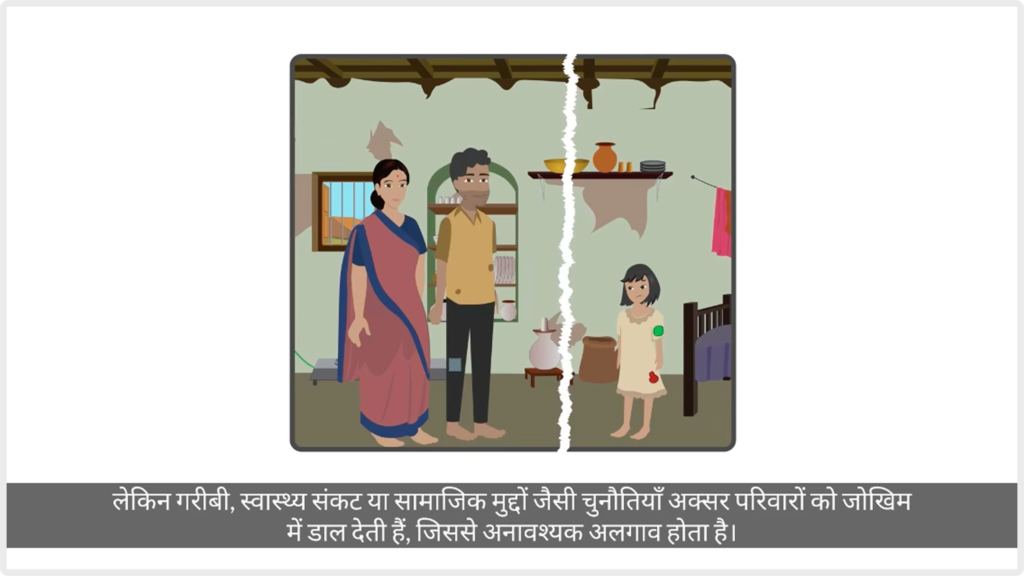
- Characters from the learner’s world: Every character is a local, rural Indian one — the families, homes, and villages on screen mirror the ones frontline workers walk into every day. When the learner recognizes the world, they trust the lesson.
- Local Languages, spoken aloud: Each course was produced in multiple local languages, with local-language voiceovers — because for this audience, audio in their own language isn’t a nice-to-have, it’s the difference between learning and not.
- Story over policy: Sensitive topics handled through story and scenario, so workers practise judgement — what would you do in this home, with this family? — rather than memorize policy.
The Pilot: Proof Before Platform
An NGO shouldn’t have to buy learning infrastructure to find out whether eLearning works for its people. So we hosted the pilot on our own internal LMS — the Foundation’s workers logged in, learned, and finished, while we monitored engagement and completion behind the scenes.
The pilot gave Miracle Foundation real data: who engaged, who completed, where learners spent time and where they dropped off — evidence to shape every decision that follows, from content to platform.
The Outcome
Miracle Foundation got more than two courses. It got proof that eLearning can reach its hardest-to-reach audience — in their languages, through characters they recognize — and the engagement data to plan what comes next with confidence. For us, it’s the project that best answers a question we care about: can thoughtful learning design work far beyond the corporate office? It can.
Building learning for an audience everyone else overlooks?
We’d love to show you how we design for the field — schedule a walkthrough of the Miracle Foundation courses.
Schedule a demo: contact@zigmalearning.in.